Global Oil: Venezuela Sees The Market Oversupplied By 9 Million Barrels Per Day
Sep. 25, 2016 6:50 PM ET
|
7 comments
|
About:
The United States Oil ETF, LP (USO), Includes:
CVX,
E,
HAL,
REPYF,
SLB,
STO,
TOT,
WFT

Richard ZeitsPremium Research »
Follow(8,036 followers)
Oil & gas, commodities, long/short equity, research analyst
Send Message
|
Zeits OIL ANALYTICS
Summary
Among OPEC members, Venezuela has been perhaps the most vocal proponent of a production control pact to support prices.
Despite optimistic promises by the country’s oil officials, PDVSA has been unable to arrest the slide in production volumes.
The decline in revenues has pushed PDVSA to the brink of a default on its bonds.

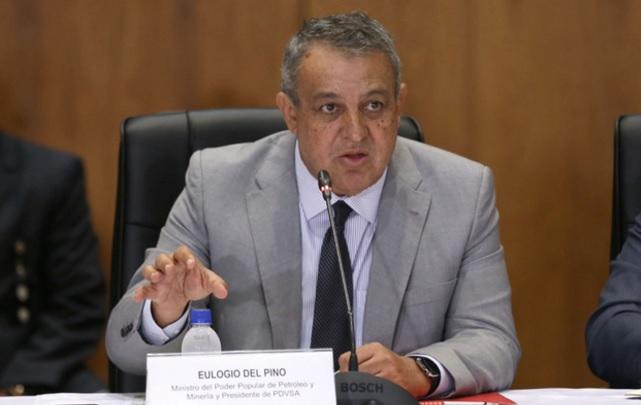
Photo: Venezuelan Minister of Petroleum and Minerals Eulogio Del Pino
Important note: This article is not an investment recommendation and should not to be relied upon when making investment decisions - investors should conduct their own comprehensive research. Please read the disclaimer at the end of this article.
As the informal meeting by the leading oil exporters in Algeria is approaching, journalists scrutinize every statement by the world's oil officials in an attempt to find cues regarding potential outcome of the meeting. The mosaic of opinions quoted is colorful and at times entertaining.
Last week, the prize for the most head-turning statement goes to Venezuela's Oil Minister Eulogio del Pino. According to a
Reuters report, the minister stated in a TV interview with state oil company PDVSA that the current global oil production needs to be reduced by 10% to meet the current level of demand. The minister was also quoted as saying that a "fair price" for oil would be around $70 per barrel.
According to
Reuters, the minister stated:
"Global production is at 94 million barrels per day, of which we need to go down 9 million barrels per day to sustain the level of consumption."
Minister del Pino's view on global oil statistics is a bit surprising. Here is OPEC's most recent estimate with regard to the current global crude production (Venezuela is an OPEC member):
World liquids supply in August 2016 decreased by 0.14 mb/d m-o-m to average 95.65 mb/d, but grew by 0.18 mb/d y-o-y.
From the same source:
…world oil demand growth [in 2016, relative to 2015 - RZ] is now pegged at 1.23 mb/d, with total global consumption at 94.27 mb/d. In 2017, world oil demand growth was kept relatively unchanged… at 1.15 mb/d, with total global consumption forecast at around 95.42 mb/d.
Given that summer demand is seasonally higher than the average for the year and using OPEC data, it is not obvious that the market was oversupplied in August or is oversupplied currently.
What would happen if Minister del Pino's wish came true and global supply unexpectedly dropped by 9 million barrels a day?
I would argue that the current global overstock would come down to a benign level within approximately a month. Within two months, the world would begin to experience acute oil shortages. Strategic petroleum reserves would be tapped.
The scenario is obviously from a fiction category. A drop of global oil production by 9 million barrels per day is inconceivable without assuming a catastrophic development such as an act of war affecting several key suppliers in the Middle East.
Venezuela's frustration with the persistently low oil prices is understandable. It is worth noting that PDVSA, Venezuela's state-owned oil company, is facing critical challenges at the moment and is on the verge of defaulting on its bonds.
PDVSA has over $7 billion in bond maturities in 2016 and 2017, of which $1.1 billion in payments is coming due on October 28, 2016, followed by $2.3 billion on November 2, 2016. To avoid a default, PDVSA has initiated a bond exchange whereby the holders of the nearest maturities will be offered to swap their bonds for a new bond maturing in 2020. The new bond will have four annual principal payments and will be collateralized with 50.1% of the shares of Citgo Holding.
According to PDVSA:
The People's Minister of Petroleum and President of Petroleos de Venezuela, S.A. (PDVSA), Eulogio Del Pino, said during a radio interview on Union Radio Circuit that holders of PDVSA 2017 Bonds who participate in the voluntary swap for new bonds that mature in 2020, will receive guaranteed bonds, timely payments and excellent returns.
The minister said that PDVSA bonds in circulation maturing in April 2017 with a coupon of 5.25%, and November 2017 with a coupon of 8.50%, can be exchanged for a guaranteed bond maturing in 2020 with a coupon of 8.50% with four annual payments of principal guaranteed by PDVSA Petróleo, SA and a collateral of 50.1% of capital of CITGO Holding, Inc.
He described as very attractive the returns from this offer, compared to other financial instruments that are below 5%. "They will have semiannual interest payments and an annual payment of principal" he said, while adding that the liquidity of PDVSA has been validated continually by auditors and investors, and PDVSA is the oil company with the largest oil reserves in the world.
"Our bondholders know we have promptly met all payments of principal and interest. If there has been an investment with strong returns it has been PDVSA bonds", he said.
Del Pino said that PDVSA is in a position to redefine its financial profile because it does not have any debt payments between 2018 and 2019 and that it has fully complied with international standards for this bond swap offer that is certainly favorable for bondholders.
There is no confidence that the exchange would succeed, even though the existing bondholders may not have much of a choice in terms of alternatives.
PDVSA has also recently restructured some of its overdue payments to Western oil service companies working in the country.
Many of the statements by Venezuela's oil minister and country officials quoted by Western media are targeted at Venezuelan audiences. However, some questions come up with regard to country strategies by Western companies in Venezuela. Many operators in the oil sector continue to be significantly involved. Examples include oil service companies such as Halliburton (NYSE:
HAL), Weatherford International (NYSE:
WFT) and Schlumberger (NYSE:
SLB) and oil majors such as Chevron (NYSE:
CVX), Total (NYSE:
TOT), Statoil (NYSE:
STO), Eni (NYSE:
E) and Repsol (
OTCQX:REPYF).
Does the benefit of the market share gain in Venezuela justify the political and commercial risks that these companies expose their shareholders' capital to?